The PYP Exhibition is a meaningful journey where Grade 5 students explore real-life issues that matter to our community and the world. It is the culminating project of the Primary Years Programme, where students demonstrate their skills in research, critical thinking, collaboration, and action. In today’s VUCA world—one that is volatile (constantly changing), uncertain (hard to predict), complex (full of interconnected challenges), and ambiguous (not always clear)—students are encouraged to develop the ability to adapt, think deeply, and make thoughtful decisions.
Throughout this process, students inquire deeply, connect their learning to global challenges, reflect through Islamic values, and take responsible action. By understanding and responding to real-world issues within a VUCA context, students become more prepared to face challenges with resilience and wisdom.
This year, the students begin their journey by identifying a real issue that impacts their daily lives and many others around the world.
The Research Team
The Mentors
Ms. Salma
Ms. Ella
Ms. Maya
Ms. Ripka
Step 1: Identifying a Globally Significant Issue
Jakarta has big transportation problems that affect many people every day. Traffic jams, air pollution, crowded public transportation, and safety issues make commuting difficult for citizens.
To help solve these problems, the government plays an important role. The government builds roads, provides public transportation such as buses and trains, and creates rules to make transportation safer and more organized. These efforts are meant to help people travel more easily, safely, and efficiently.
However, transportation problems still happen in many big cities, including Jakarta. Because of this, governments need to continue improving transportation systems to meet citizens’ needs.
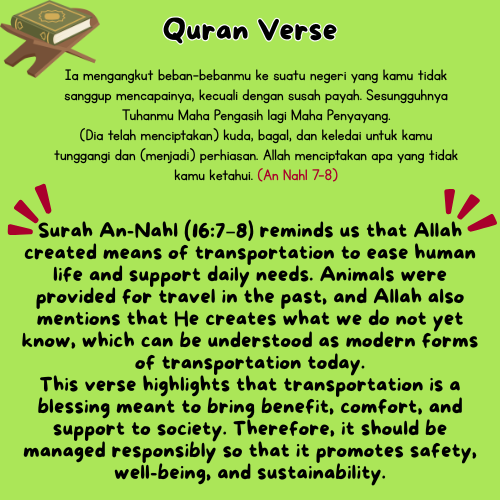
From an Islamic perspective, transportation is a blessing from Allah that helps make human life easier. In Surah An-Nahl (16:7–8), Allah explains that transportation is created to bring comfort and benefit to people.
This makes us think about an important question: How does the government support the citizens’ needs in commuting?
Within the Doughnut Model, transportation in Jakarta connects to several key dimensions of both social and environmental sustainability.
Air pollution represents the environmental impact of transportation systems, particularly through vehicle emissions that contribute to climate change and reduced air quality.
Networks refer to mobility and connectivity, emphasizing the importance of accessible and efficient transport systems that enable people to participate fully in society.
Income & Work highlight the economic dimension, as reliable transportation directly influences access to employment and financial stability.
Health underscores the need for safe, clean, and well-managed transportation systems that protect public well-being.
These interconnected areas demonstrate that transportation is not merely a logistical concern but a critical factor influencing environmental balance, social equity, and economic opportunity.
Step 2: Defining Time Frame
Step 3: Inquiring
Engaging Support From Learning Community
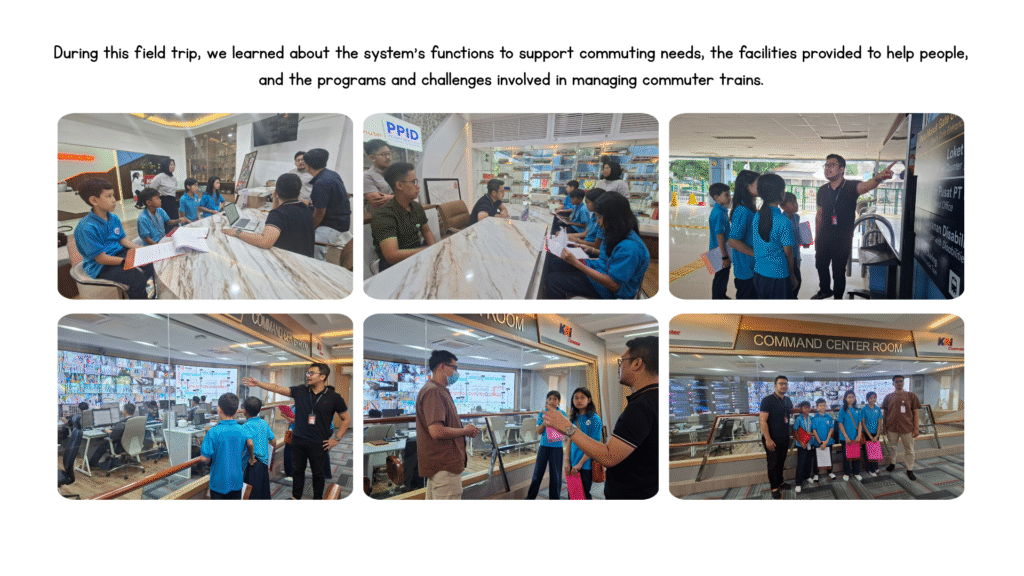
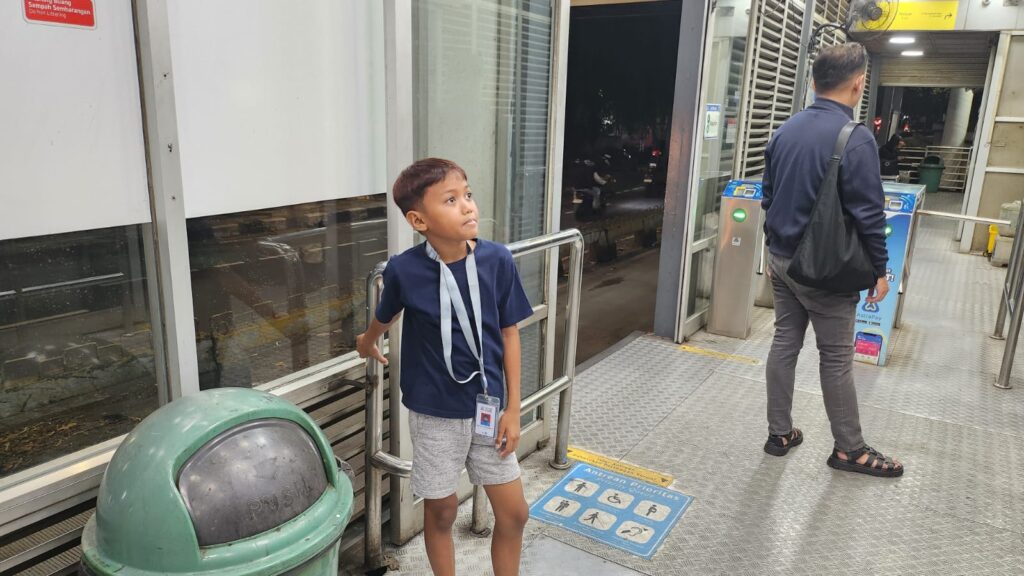
To achieve our goals in the PYP Exhibition, we worked collaboratively, set clear timelines, and engaged our learning community for support. Students, teachers, mentors, parents, guest speakers, and field trip experiences all contributed by sharing ideas and providing continuous feedback throughout the process. Through a field trip using public transportation and two visits with guest speakers, we gathered information about public transportation and learned about the government’s role in managing and improving it. To monitor our progress, we held mentor meetings three times a week and consistently completed the PYP Exhibition journal as part of our collective responsibility.
Parents-Mentors Meeting and Students-Mentors Meeting
Field Trips and Guest Speakers
1. Public Transportation Exploration and Interviews
2. Guest Speaker Session with Jakarta Transportation Department
3. Field Trip to KAI Commuter: Understanding Train Systems
Step 4: Organizing Data
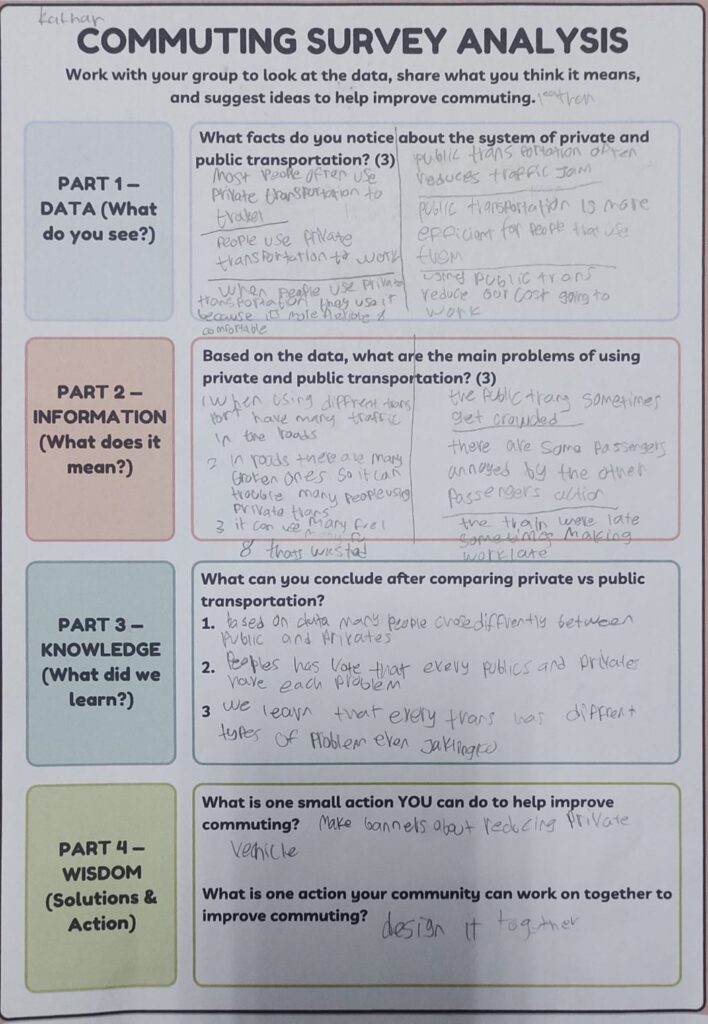
After our field trips, we created a questionnaire to collect real data and understand people’s experiences, opinions, and challenges related to commuting and public transportation. Through this questionnaire, we collected data on commuting problems, the function of transportation systems, and the roles of the government and citizens in supporting public transportation.
Of the 159 respondents, 76.7% use private vehicles, mainly because 89.3% believe it is more efficient. The main reason is flexibility: they can leave and return anytime, anywhere, and they feel more comfortable doing so.
Meanwhile, 96.9% of public transportation users believe it is more efficient than private vehicles, and 50% say it is more practical.
Overall, 78% of respondents think that public transportation in the city is functioning quite well, and 88% agree that public transportation can help reduce traffic congestion, which is the main commuting problem. In addition, 64.8% feel that public transportation meets daily commuting needs, and 61.6% think the government has provided enough support. However, overcrowding during peak hours remains a challenge.
OUR ANALYSIS
Based on our experience, the comfort level of public transportation is already good, especially in MRT, LRT, and KRL Commuter. However, many people are still not familiar with how the system works, which makes them less interested in trying it.
From this data, we can conclude that although many people believe public transportation is a solution to traffic congestion, they still choose private vehicles for their flexibility and comfort. This is one of the reasons traffic congestion persists. Another reason is that not everyone understands how to use public transportation, so they prefer to stick with what they already know. Therefore, improving public awareness, accessibility, and convenience is important to encourage more people to use public transportation.
Step 5: Sharing Our Exhibition
Based on our analysis, we found that many people do not fully understand how to use public transportation, so they prefer to continue using what they are already familiar with. Therefore, raising awareness, improving accessibility, and increasing convenience are important to encourage more people to use public transportation.
As our action, we started with ourselves by choosing to use public transportation to get to school and travel with our families. We also aimed to spread knowledge among the Al Jabr school community and the wider public, building awareness and encouraging others to use public transportation.
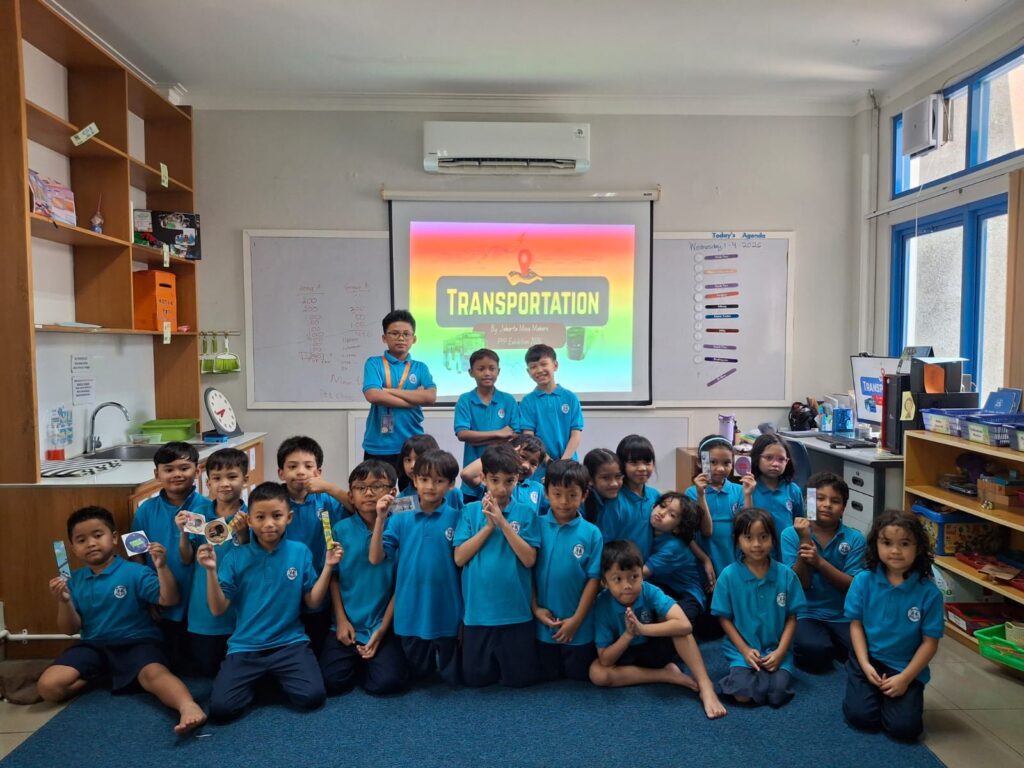
To support this, we created various media such as a storybook, a comic, bookmarks, stickers, and a video to share our message in a fun and engaging way.
Change starts from ourselves
ACTION: Lifestyle Choices
Our Community
ACTION: Advocacy (First and Ninth Grader)
We shared our knowledge of public transportation with first graders to introduce different types, the rules, and how to use them.
We also shared our knowledge with ninth graders to raise awareness and encourage them to start using public transportation.
Wider Community
We uploaded our video encouraging people to use public transportation on our parents’ social media accounts and tagged government and public transportation organizations such as @dkijakarta, @dishubdkijakarta, @kemenhub151, @commuterline, and @pramonoanungw.
Through this action, we hope to reach a wider community and inspire more people to be brave and willing to try public transportation. By doing this together, we believe we can help reduce commuting problems and create a better environment for everyone.